
How Long Do You Have to Claim Delay Repay from Southeastern? The 28-Day Rule Explained
The Southeastern Delay Repay window is exactly 28 days from the date of the delay. Once it closes, the compensation is gone. Here's what the rule means in practice — and how to make sure you act in time.
Rail Repay Podcast
How Long Do You Have to Claim Delay Repay from Southeastern? The 28-Day Rule Explained
Enjoy the related dialogue — a two-voice conversation on this topic.
The answer is twenty-eight days. From the date of the delay, not from when you remember it happened. Not from when you finally got round to opening the portal. From the day the train arrived late.
That window is strict. Once it closes, Southeastern is not obliged to accept the claim — and in practice, they don't.
Why 28 Days?
The 28-day window comes from the National Rail Conditions of Travel (2025, Clause 32). This is the framework that governs how train operators in Great Britain run their Delay Repay schemes. Most operators running DR15 — including Southeastern — enforce this window strictly.
The reasoning is administrative: operators need a defined window for claims reconciliation. From a passenger's perspective, it feels like a deadline designed to catch you out. In practice, it often does — not through malice, but through the perfectly predictable way that frustration fades, days slip by, and paperwork gets deprioritised.
The Psychology of the Missed Window
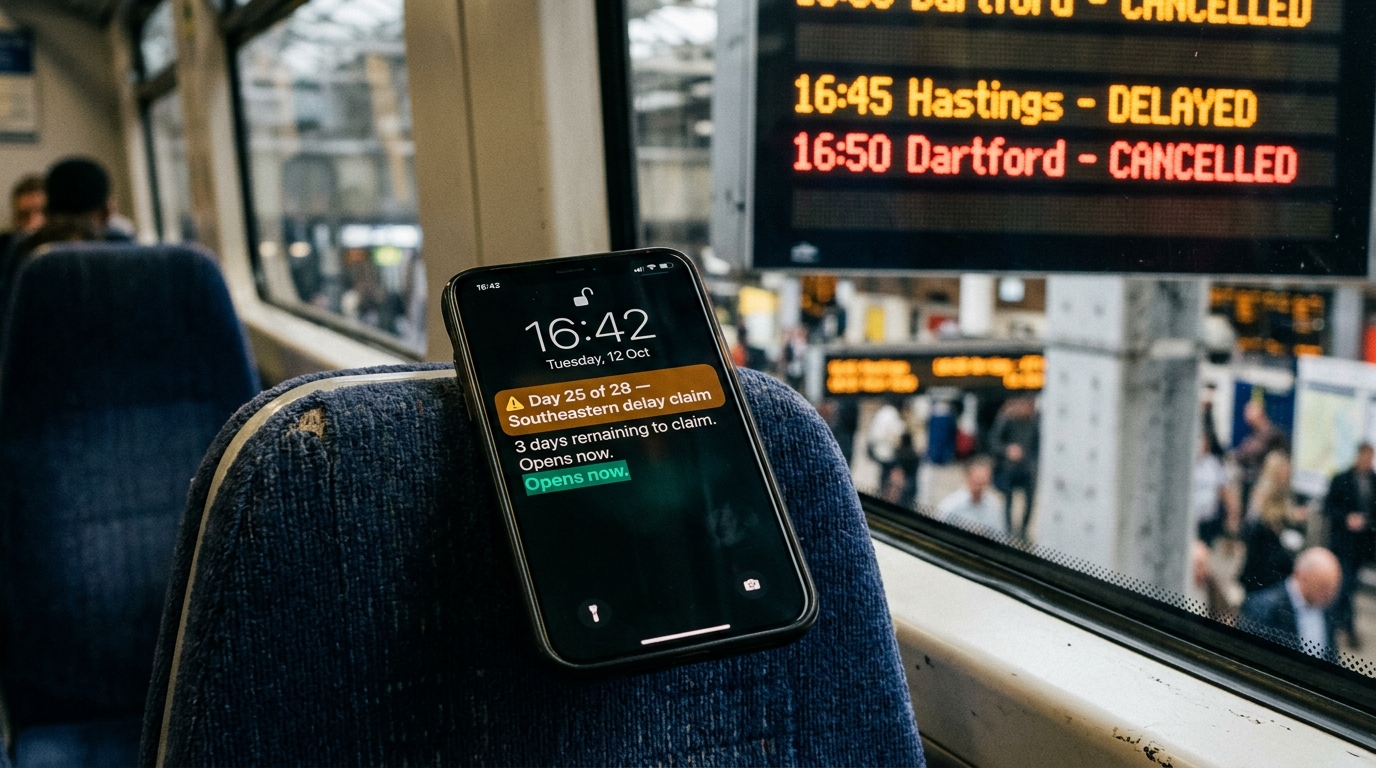
The first 24 hours after a delay: you are annoyed but the journey is still vivid. Day three: the specific details are fading. Day ten: you half-remember there was a delay. Day twenty-eight: the window closes. The money stays with Southeastern.
This is not a failure of intention. It is a structural problem. The claim requires specific information — the exact service, the delay in minutes, your ticket reference — that becomes harder to locate as time passes. And unlike a bill or a renewal, there is no reminder that the 28-day window is closing.
What You Need to Claim in Time
If you have a qualifying Southeastern delay from the last 28 days, here is what to gather before the window closes:
- ·Journey date — the exact date the delay occurred
- ·Route — origin and destination stations
- ·Scheduled departure time — from the timetable (not the actual time)
- ·Actual arrival time — check Real Time Trains (realtimetrains.co.uk) if you're unsure
- ·Ticket type and price — annual season, monthly, day return, single
- ·Booking reference — if applicable
What Rail Repay Changes
Rail Repay sends you an alert on the day a qualifying delay is detected on your registered route. The alert contains the information you need: the service, the delay duration, the compensation tier.
You do not need to remember which day the delay was. You do not need to find the scheduled arrival time on a historical timetable. The information is ready when the window opens — not when it is about to close.
The 28-day clock still runs. But with same-day alerts, you are acting on day one rather than day twenty-seven.
The Takeaway
Twenty-eight days from the delay date. That is the Southeastern Delay Repay window. If you have a qualifying delay from the last four weeks, the window may still be open.
Check at railrepay.co.uk — free, no card needed.
Sources:
- •National Rail Conditions of Travel 2025, Clause 32 — nationalrail.co.uk
- •Southeastern Delay Repay portal — delayrepay.southeasternrailway.co.uk
- •Real Time Trains — realtimetrains.co.uk
Stop leaving money on the platform
Check what your Southeastern route may owe you — in 60 seconds
Free delay alerts + AI claim drafts. No card required. You stay the claimant.
You might also like

This article is informational and is not legal advice. See the legal basis and sources. The train company decides the final eligible amount after validating your ticket, journey, and delay evidence. Legal basis and sources