
The Departure Board Lied to You — Why Delay Repay Is About Where You Arrive, Not When You Leave
Your train left on time. You still arrived 22 minutes late. Most passengers never claim because they checked the departure board, not the arrival. Here is the rule that changes everything.
Rail Repay Podcast
The Departure Board Lied to You — Why Delay Repay Is About Where You Arrive, Not When You Leave
Enjoy the related dialogue — a two-voice conversation on this topic.
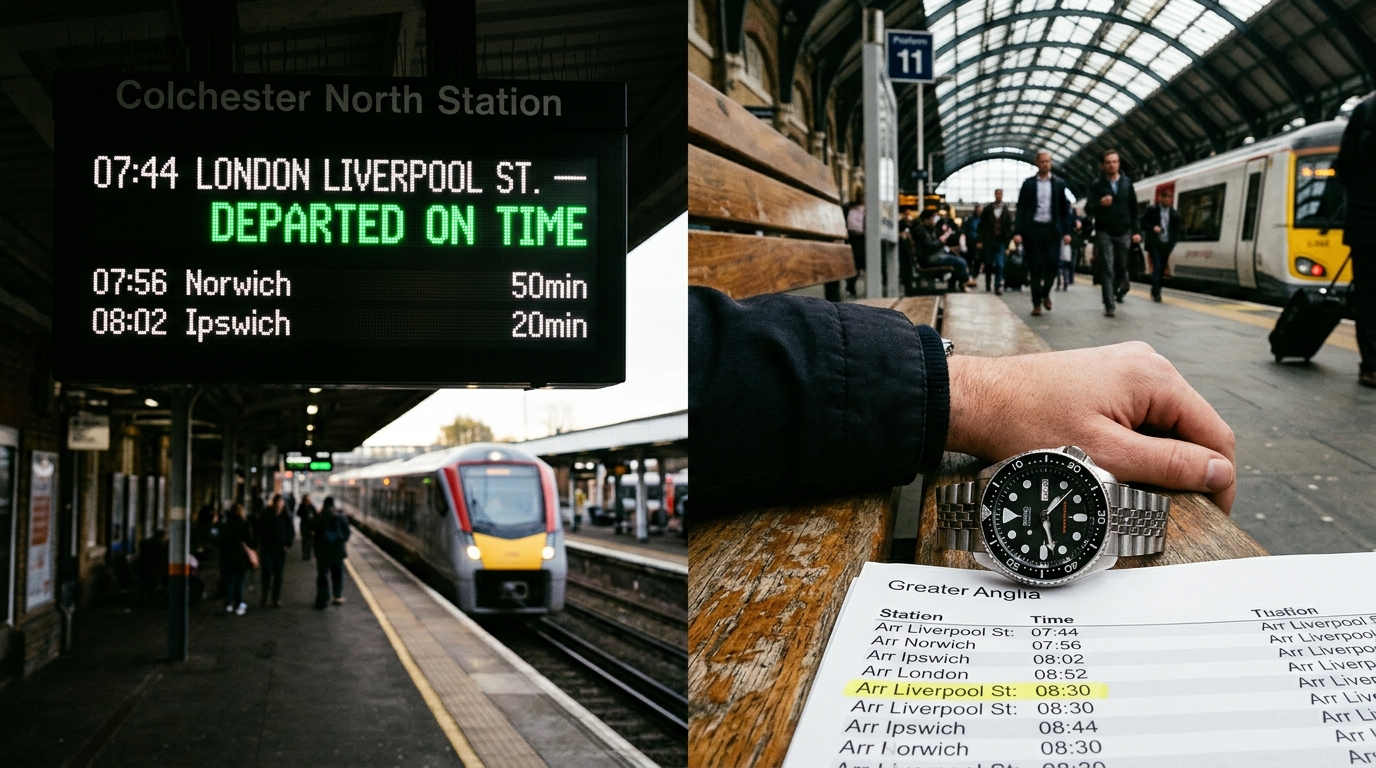
The departure board at Colchester North said "On time." The 07:44 left at 07:44 exactly. You noticed. You relaxed. And you arrived at Liverpool Street at 08:52 — twenty-two minutes after the scheduled 08:30 arrival.
You never claimed.
Neither did most of the people in that carriage.
The Measurement That Actually Matters
Delay Repay is not calculated from when your train leaves. It is calculated from when you arrive.
The National Rail Conditions of Travel (2025, Clause 30) is unambiguous on this point: compensation eligibility is based on arrival at the passenger's destination station, not departure from the origin. A train that departs perfectly on time can still trigger a valid claim if it arrives late.
This is the rule most passengers never learn — and it is the reason billions of pounds in legitimate compensation goes unclaimed every year.
How an On-Time Departure Becomes a Late Arrival
The most common cause is what engineers call a "speed restriction" mid-route. A train departs Colchester on schedule. Somewhere between Chelmsford and Stratford, it encounters a signal fault or a section of track under temporary restriction. The driver has no choice but to slow. By the time the train reaches Liverpool Street, it is eighteen minutes late.
The departure board at Colchester showed nothing unusual. The arrival board at Liverpool Street told a different story. For the passengers on that service, Delay Repay 15 applied — if they knew to look at the arrival time, not the departure.
A second scenario catches even more people out: the missed connection. Your first train runs perfectly — departed on time, arrived on time. But you needed to connect at Stratford, and the connecting service was held, or cancelled, or already gone. Your actual arrival at your destination is forty minutes past schedule. Both legs of your journey may be eligible for consideration, and the final arrival delay is what determines your compensation tier.
The Departure Board Is the Wrong Scoreboard
The departure board is the most visible piece of information at any station. It is large, well-lit, and designed to answer the question passengers ask most often: will my train leave on time?
But Delay Repay answers a different question: did you arrive on time?
Greater Anglia's Delay Repay team verifies claims against its own confirmed service performance record — what the train actually did at each station, not what the departure board showed. Rail Repay's data team independently monitors the same underlying rail-service picture: a continuous feed of arrival performance data that our analysts track, cross-reference, and validate to surface qualifying delays automatically. It does not look at what the departure board said. It looks at what the train actually did.
If your train arrived 15 or more minutes late at your destination, you may be owed compensation — regardless of what the departure board showed when you boarded.
The Gap Between What Passengers See and What the Data Shows
The practical result of this confusion is significant. Passengers who experienced a delay often do not realise they have experienced a delay. They check the departure time, see "on time," and assume the journey was fine. The frustration they feel — arriving late, rushing through the gateline, missing the first ten minutes of the meeting — never connects to a compensation claim, because they never had reason to question the departure information.
Rail Repay resolves this by monitoring arrival data, not departure announcements. When your registered route arrives late by 15 minutes or more, you are notified — regardless of whether the train appeared on time when it left.
The Counter-Intuitive Bit
Here is something that surprised me when I first looked at the data properly: a small number of Greater Anglia services depart Colchester North late but still arrive at Liverpool Street roughly on time — because drivers recover time on the fast section between Chelmsford and Stratford. No delay, no claim.
But the reverse also happens: a service departs on time, encounters a signal restriction mid-route, and arrives late. That is a claim. And because passengers never saw a departure delay, they never thought to check.
Rail Repay watches the arrival, not the departure. The distinction sounds technical. In practice, it is worth several pounds per incident.
Worth knowing: if you are checking delays manually, Real Time Trains (realtimetrains.co.uk) archives arrival and departure data for at least 90 days. You can look up any Greater Anglia service by station and date, and see the actual recorded arrival time. Free to use, no account needed.
What This Means in Practice
If you commute from Colchester, Chelmsford, or Ipswich to Liverpool Street, it is worth reviewing your recent journeys. A service that departs at 07:44 and is scheduled to arrive at 08:30 may have arrived at 08:47 on multiple occasions — generating compensation entitlements you were never aware of.
The 28-day deadline applies from the date of each delay. If you have unreviewed journeys in the last four weeks, the window is still open.
Check what you may be owed — free, no card needed — at railrepay.co.uk.
Sources:
- •National Rail Conditions of Travel 2025, Clause 30 — nationalrail.co.uk
- •ORR: Know Your Rail Rights — orr.gov.uk
- •Greater Anglia Delay Repay — greateranglia.co.uk
Stop leaving money on the platform
Check what your Greater Anglia route may owe you — in 60 seconds
Free delay alerts + AI claim drafts. No card required. You stay the claimant.
This article is informational and is not legal advice. See the legal basis and sources. The train company decides the final eligible amount after validating your ticket, journey, and delay evidence. Legal basis and sources