
The £6,050 Season Ticket Has a Hidden Tax. It's Called Unclaimed Delays.
Your annual season ticket says £6,050. But the real cost of your commute is higher — because every qualifying delay you don't claim is money you've paid for a service that wasn't fully delivered. Here's the maths.
Rail Repay Podcast
The £6,050 Season Ticket Has a Hidden Tax. It's Called Unclaimed Delays.
Enjoy the related dialogue — a two-voice conversation on this topic.
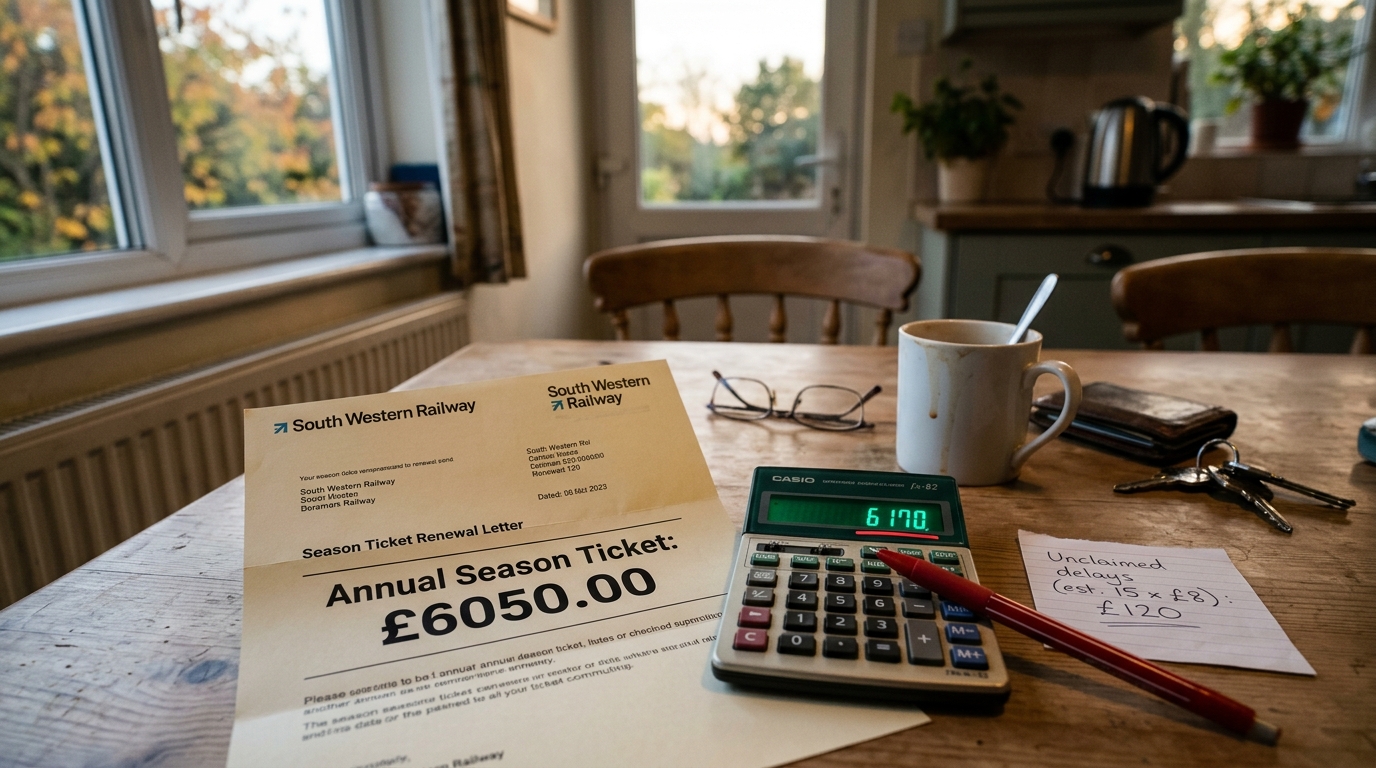
The annual season ticket from Colchester to Liverpool Street costs £6,050.
That is the number you know. It is the number on the renewal notice, the number your employer may reimburse, the number that went up in January and prompted a moment of quiet calculation about whether working from home a few more days might actually pencil out.
The number most commuters do not know is the one above it.
The Real Cost of Your Commute
Every qualifying delay on your Greater Anglia service represents compensation you are entitled to claim. Under the National Rail Conditions of Travel, a train arriving 15 or more minutes late at your destination triggers Delay Repay. For a Colchester to Liverpool Street annual season ticket holder, a 30-minute delay is worth approximately £6.52.
When you do not claim that £6.52, it does not disappear. It stays with Greater Anglia.
You have paid £6,050 for a service that, over the course of the year, delivered some of your journeys late. The difference between what you paid and what the service agreement says you are owed back is the hidden cost — the amount by which your effective commute spend exceeds the stated price.
If you experience fifteen qualifying delays in a year at an average compensation of £8 per claim, and you claim none of them, your effective commute cost is not £6,050. It is £6,170.
This Is Not About Extra Money
It is worth being precise about what Delay Repay is and what it is not.
It is not a loyalty bonus. It is not a goodwill payment. It is not "extra money" you happen to be eligible for. It is a contractual obligation — a defined financial consequence, set out in the terms of the service you purchased, when the service fails to deliver what it promised.
Framing it as "free money" or "bonus cash" slightly misses the point. The correct frame is: you have already paid for this. The delay compensation is the portion of what you paid that corresponds to a service you did not receive. Claiming it is not getting something extra — it is not overpaying for something you bought.
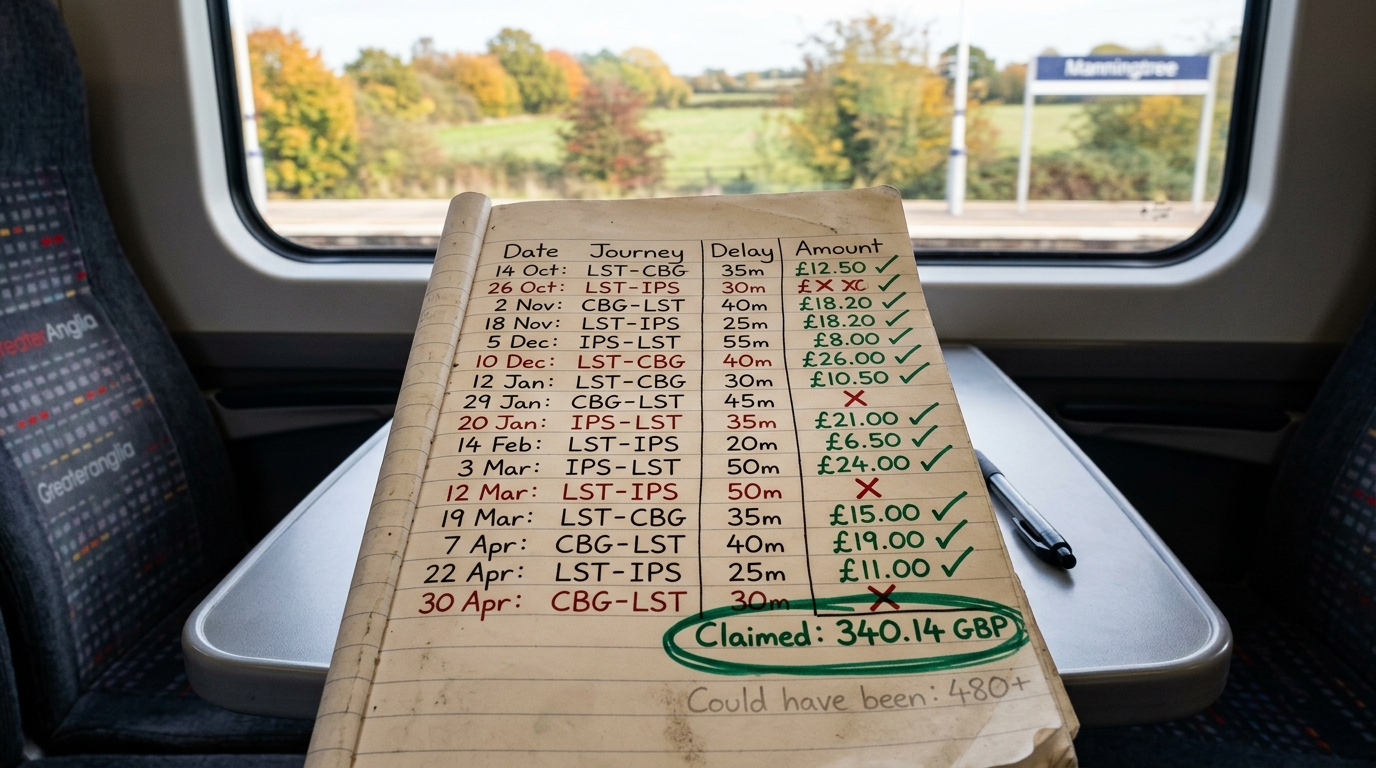
ORR consumer research indicates that around 70% of eligible passengers do not claim. At the aggregate level, that means the majority of unclaimed compensation stays with the operators. It is, from the operator's perspective, an efficient arrangement.
The Scale of the Quiet Transfer
Take the broader picture for a moment. Greater Anglia carries hundreds of thousands of passengers on the main line every year. A fraction of qualifying delays are claimed. The remainder — the 70% ORR data suggests — quietly cancel themselves out.
For individual passengers, the scale is smaller but real. A passenger experiencing the ORR-suggested average number of qualifying delays, claiming none, overpays their effective commute cost by roughly £75 to £200 annually. Not relative to some abstract ideal — relative to the compensation scheme that the National Rail Conditions of Travel says they are entitled to.
Here is a number that rarely gets discussed in fare rise coverage: ORR consumer data indicates that the total value of unclaimed Delay Repay across UK passengers runs into the tens of millions of pounds per year. That is not a rounding error. It is a structural feature of a scheme that requires passengers to initiate every claim.
The 2026 fare rise increased this unclaimed pool by approximately 4.6%. Automatically. Without any announcement.
What Consistent Claiming Looks Like
A passenger who registers with Rail Repay and claims every qualifying delay they receive an alert for does not receive a windfall. They receive approximately 2% to 3% of their annual season ticket cost returned across the year — compensation for specific journeys that arrived late, paid at the rates prescribed by the Delay Repay 15 scheme.
The effective cost of their commute comes down. Not dramatically. But measurably.
£6,050 becomes something closer to £5,900 once the compensation is returned. Which is still a large number. But it is a number that accurately reflects what the service actually delivered — rather than the higher figure that results from paying for something and not collecting the portion you were owed back.
One commuter described it as "the first year I didn't feel like I was paying twice for a journey that went wrong." That is a reasonable way to think about it. You are not getting a discount. You are just stopping a small, regular overpayment from continuing indefinitely.
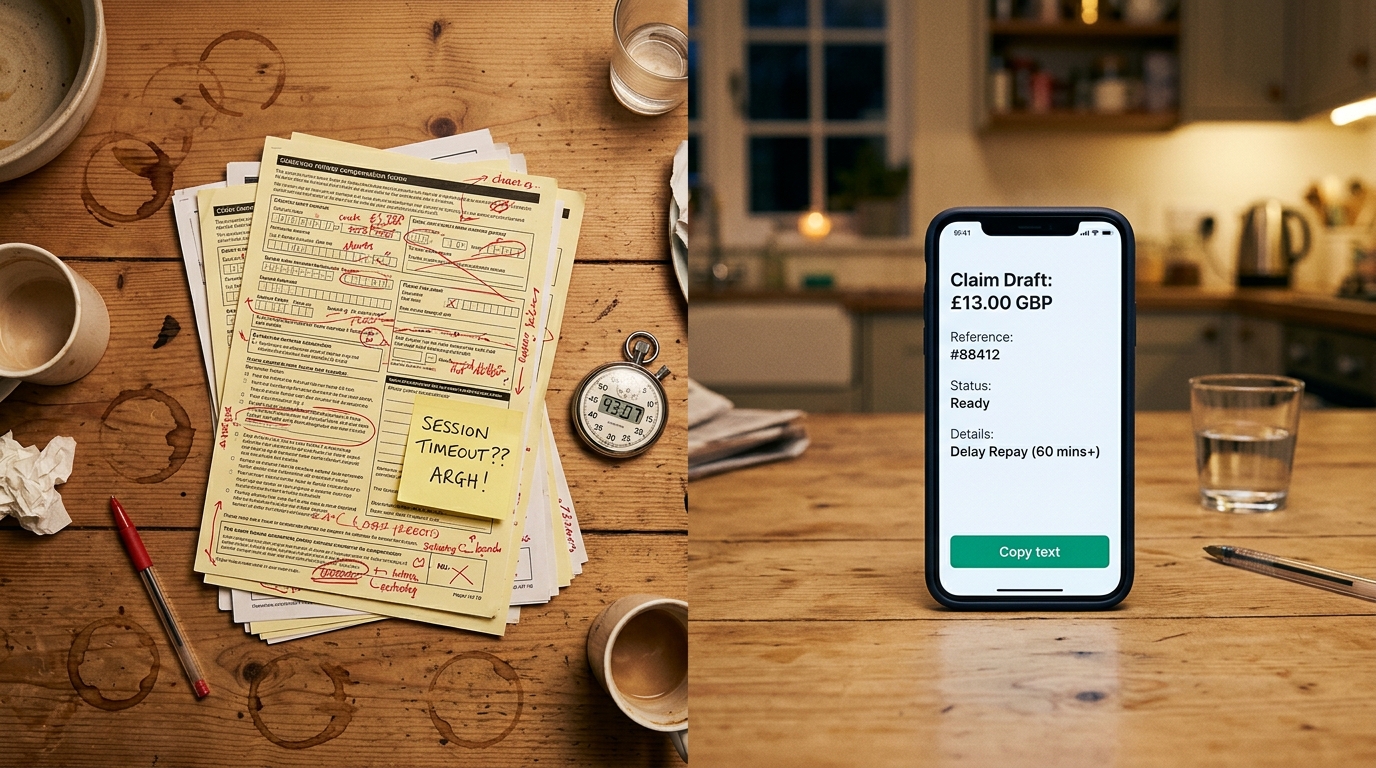
And when you do file: bank transfer, always. For claims above £13, bank transfer is simpler and faster.
Check what you may be owed — free, no card needed — at railrepay.co.uk.
Sources:
- •ORR Rail Performance Statistics Q4 2024-25 — orr.gov.uk
- •National Rail Conditions of Travel 2025, Clause 32 — nationalrail.co.uk
- •Greater Anglia Delay Repay — greateranglia.co.uk
Stop leaving money on the platform
Check what your Greater Anglia route may owe you — in 60 seconds
Free delay alerts + AI claim drafts. No card required. You stay the claimant.
You might also like
This article is informational and is not legal advice. See the legal basis and sources. The train company decides the final eligible amount after validating your ticket, journey, and delay evidence. Legal basis and sources