
Your Student Railcard Cuts Your Fare — But Not Your Delay Repay Rights
The Student Railcard gave you 1/3 off your train fare. Delay Repay is calculated on the price you actually paid. Here is what that means for your compensation — and why it is still worth claiming every time.
Rail Repay Podcast
Your Student Railcard Cuts Your Fare — But Not Your Delay Repay Rights
Enjoy the related dialogue — a two-voice conversation on this topic.
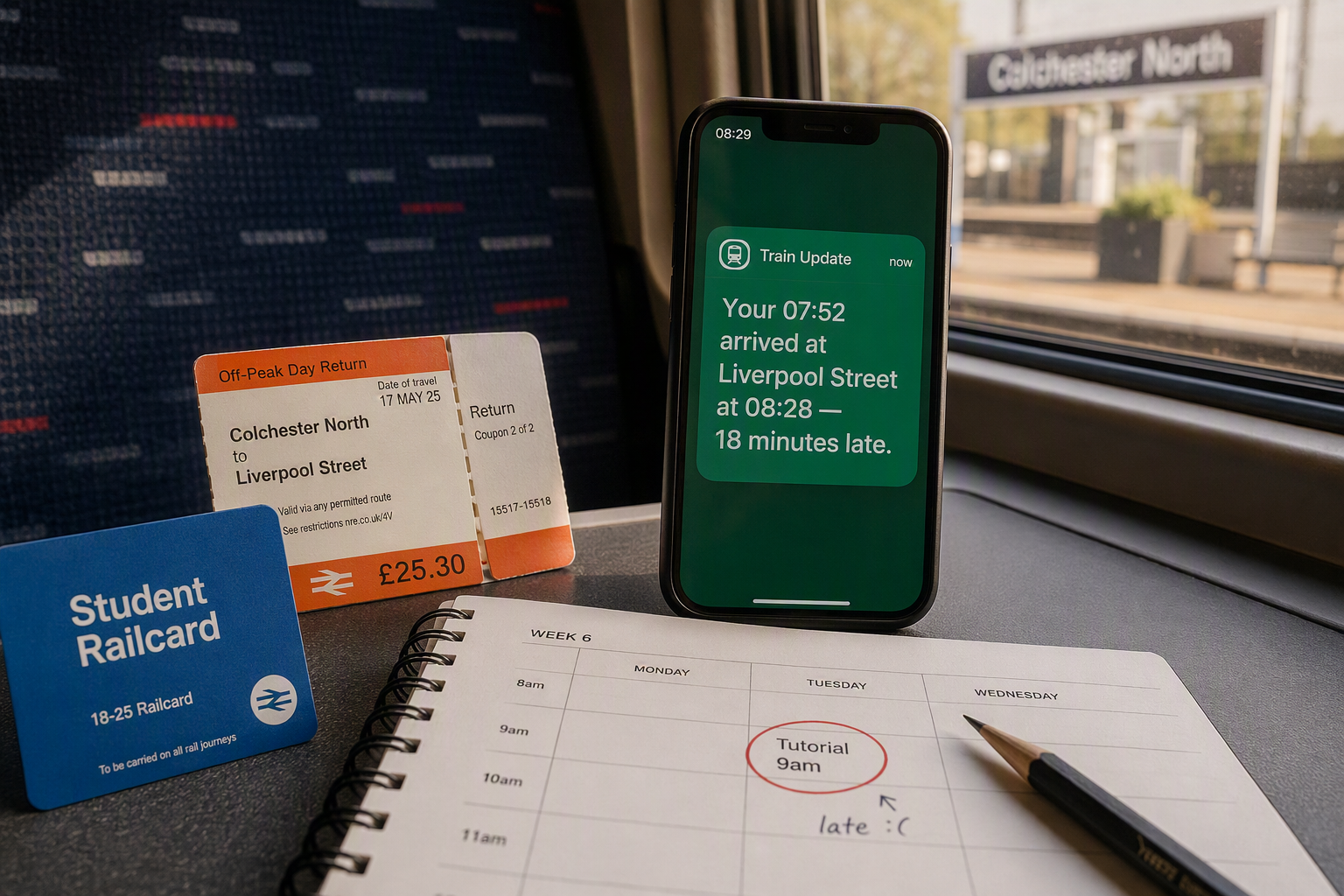
The 07:52 from Colchester North. You're running on four hours of sleep and a bag that weighs more than it should. Tutorial at nine. The train is eighteen minutes late into Liverpool Street. You made it — just — and spent the rest of the morning thinking about anything except a compensation claim.
That was £11.70 you left on the platform.
The Railcard Question Most Students Never Ask
The Student Railcard saves you one third off most rail fares. Which is genuinely useful. At £30 for the year, it pays for itself quickly on any regular journey.
But here is the question that does not come up in the freshers' fair leaflet: when your train runs late, how is your Delay Repay calculated?
The answer is straightforward, and it is actually in your favour: compensation is calculated from the fare you actually paid — the discounted price, not the full fare. This is set out in the National Rail Conditions of Travel (2025, Clause 32). The railcard holder and the passenger who paid full price are treated equally in the scheme — each receives compensation based on what they personally spent.
The Numbers
For a day return from Colchester to Liverpool Street, the standard adult fare is approximately £38. With a Student Railcard discount of one third, you pay around £25.30.
If your train arrives 30 to 59 minutes late, Delay Repay pays 50% of your single-leg value:
- •Standard adult single: roughly £19 → compensation ≈ £9.50
- •Student Railcard single: roughly £12.65 → compensation ≈ £6.30
- •Student Railcard single: roughly £12.65 → compensation ≈ £12.65
Why Students Often Miss This
There are two assumptions that work against student commuters when it comes to Delay Repay.
The first is the belief that a discounted fare means a negligible claim. "I only paid £25, it's not really worth it." But £6 to £12 per qualifying delay adds up. If you commute twice a week through a term and experience four qualifying delays, that may be £25 to £50 in unclaimed compensation — enough to cover a week of groceries, or the textbook you've been borrowing.
The second assumption is that the Delay Repay form requires documentation proving the railcard discount. It does not. You enter the ticket type and price you paid. Greater Anglia calculates your entitlement from that.
Monthly Season Tickets and the Railcard Minimum Fare
One important note for students with a monthly season ticket: the Student Railcard cannot be used with all season ticket purchases in all regions. On the Greater Anglia main line (Colchester, Chelmsford, Ipswich to London), railcard discounts on season tickets are subject to a minimum fare rule — the discounted price cannot fall below a set threshold.
This does not affect your Delay Repay rights. Whatever price you paid for your season ticket, that is the basis for your compensation calculation. The 1/464 divisor (for annual tickets) or 1/40 (for monthly) still applies to the price you actually paid.
Across a Term: What the Claims Add Up To
A university term is roughly twelve weeks. A student commuting twice a week faces around 24 journeys. ORR data for the Greater Anglia main line suggests roughly one in four journeys arrives measurably late at the destination. Of those, a proportion will reach the 15-minute qualifying threshold.
If you experience four qualifying delays per term — which is conservative for regular commuters — at an average of £8 per claim, that is £32 per term, or roughly £96 per academic year.
That is not transformational. But it covers three months of groceries, or the textbook you have been sharing with someone you barely know. It is real money, and it belongs to you.
One thing that surprised me about student Delay Repay: the Railcard time restriction means that if you are travelling before 10:00 on a weekday — which most students with morning lectures are — you may have paid the full adult fare, not the discounted price. If so, your compensation calculation is based on the full fare, which is actually more favourable. Worth checking your ticket receipt.
The 28-Day Clock Still Applies
Every Delay Repay claim has a 28-day deadline. This does not extend for exam periods, placement years, or any other circumstance. If you experienced a qualifying delay in the last four weeks, the window is still open.
Rail Repay monitors your registered Greater Anglia route in real time and sends you an alert on the day a qualifying delay occurs — while the details are fresh and the motivation to claim is still there.
Check what you may be owed — free, no card needed — at railrepay.co.uk.
Sources:
- •National Rail Conditions of Travel 2025, Clause 32 — nationalrail.co.uk
- •Greater Anglia Delay Repay — greateranglia.co.uk
- •Network Rail Railcard guide — railcard.co.uk
Stop leaving money on the platform
Check what your Greater Anglia route may owe you — in 60 seconds
Free delay alerts + AI claim drafts. No card required. You stay the claimant.
You might also like
This article is informational and is not legal advice. See the legal basis and sources. The train company decides the final eligible amount after validating your ticket, journey, and delay evidence. Legal basis and sources