
You Only Commute Twice a Week. Both Times the Train Was Late. That's Still Money.
Hybrid workers often assume Delay Repay is for daily commuters with season tickets. It isn't. Every qualifying journey counts — and occasional commuters on day returns may be owed more per trip than they think.
Rail Repay Podcast
You Only Commute Twice a Week. Both Times the Train Was Late. That's Still Money.
Enjoy the related dialogue — a two-voice conversation on this topic.
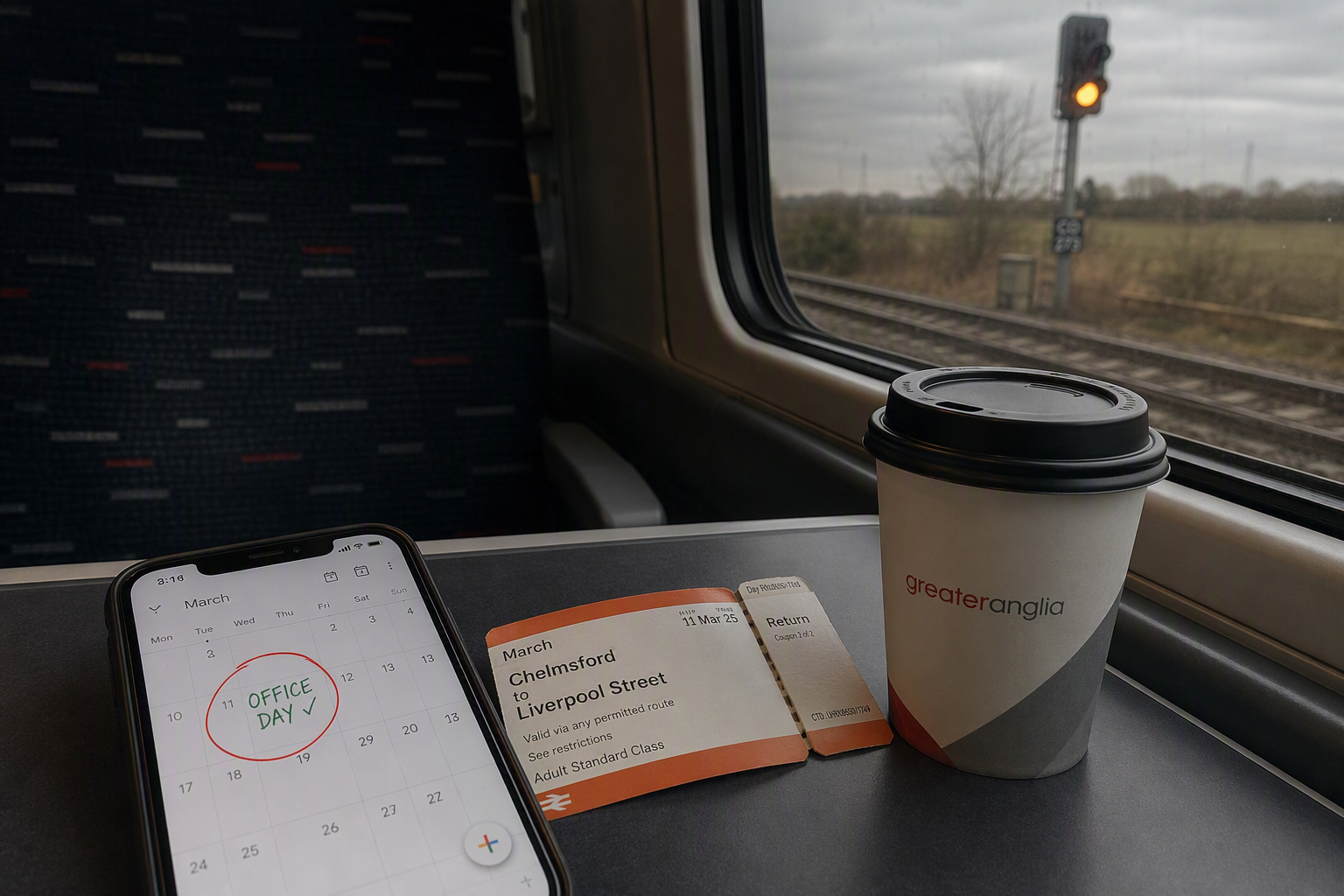
You work from home most days. Tuesday was an office day — one of maybe two this week. You got to Chelmsford station at 08:15, got on the 08:22 to Liverpool Street, and spent the next thirty-five minutes watching an amber signal light somewhere outside Stratford that did not seem to be in a hurry to change.
You arrived at nine o'clock. You had a meeting at eight fifty-five. The first five minutes were already gone by the time you found a seat and opened your laptop.
You did not claim. You barely travel — it felt like it did not count.
Here is the part that surprises most hybrid workers: occasional commuters on day returns are often owed more per claim than annual season ticket holders on the same route. Not less. More. Because the face value of a day return is the basis for the calculation — with no divisor applied.
It counts.
Delay Repay Is Not Just for Daily Commuters
The most common misconception about Delay Repay is that it is designed for people who commute every day on a season ticket. It is not. Compensation eligibility under the National Rail Conditions of Travel applies to every qualifying journey — regardless of how often you travel.
If you bought a ticket, travelled on that ticket, and arrived 15 minutes or more late at your destination, you may be owed compensation. The scheme does not ask how many days a week you usually commute.
Why Occasional Commuters Are Often Worth More Per Journey
There is an irony in the Delay Repay calculation that most hybrid workers never discover.
Annual season ticket holders use the 1/464 divisor to calculate their single-leg value. For a £6,050 annual ticket, that is £13.04 per leg. A 30-minute delay pays 50%, so roughly £6.52.
Occasional commuters on day returns are treated differently. The face value of the fare is the basis for the calculation — no divisor. A day return from Chelmsford to Liverpool Street costs approximately £38. A 35-minute delay entitles you to 50% of the return fare value:
50% of £38 = £19
That is almost three times the per-journey compensation of an annual season ticket holder experiencing the same delay on the same route.
You are, in this specific sense, worth more per trip — because you are paying the undiscounted walk-up price for each journey.
Worth knowing: If you work from home two or three days a week and take day returns, it is worth checking whether an off-peak weekly or monthly season ticket makes financial sense. The crossover point where a season ticket becomes cheaper than repeat day returns is often lower than people expect — particularly since the 2026 fare changes. The National Rail journey planner shows fares by ticket type.
The Psychology of Not Claiming
Hybrid workers have a particular reluctance around Delay Repay that regular commuters tend not to. It usually sounds something like this:
"I barely use the train. I'm not one of those people who depends on it daily. Claiming feels a bit much."
This is understandable. It is also incorrect.
The compensation is not a loyalty programme for frequent travellers. It is a formal contractual entitlement under the terms of the service you purchased. You paid for a journey that was supposed to arrive on time. It did not. The difference — the 35-minute gap between the timetable and reality — has a monetary value, and that value belongs to you.
Greater Anglia does not discount your claim because you also own a bicycle. The scheme does not check how many rail journeys you made last month.
How Rail Repay Works for WFH Commuters
The practical challenge for non-daily commuters is remembering to check whether a particular journey was delayed. You are not in the rhythm of daily monitoring. A 35-minute delay happens on a Tuesday, you get to the meeting barely on time, and by the following Friday the details are gone.
Rail Repay monitors your registered Greater Anglia route continuously. When a service on your route arrives 15 or more minutes late, you receive an alert that day — with the AI-drafted claim text ready to copy. You do not need to remember the exact service time, check the data yourself, or keep the ticket stub.
If you travel the Chelmsford or Colchester to Liverpool Street route even occasionally, the route is worth registering. You only need to do it once.
The Maths of an Occasional Commuter's Year
Two office days per week, fifty weeks per year: that is one hundred journeys. ORR data for the Greater Anglia main line suggests roughly one in four services arrives measurably late at the destination. That is twenty-five qualifying delays across the year.
At an average claim of £12 per incident (a mix of 30-minute and longer delays at face value), that is £300 per year in potential compensation — from a commute that only happens twice a week.
That is an approximation. Your route, ticket price, and actual delay frequency will vary. But the direction of the number is clear: the claim potential for hybrid workers is material, and almost entirely unclaimed.
The seasonal pattern is also worth noting. Autumn and winter — specifically October through February — historically produce more qualifying delays on the Greater Anglia main line, as signal faults and speed restrictions increase. The leaves-on-the-line season, which sounds faintly comedic, has a measurable impact on punctuality data. If your office days tend to cluster in autumn and winter, your claim potential per year may be higher than the annual average suggests.
The 28-day deadline applies to each journey individually. If you were delayed in the last four weeks, the window is still open.
Check what you may be owed — free, no card needed — at railrepay.co.uk.
Sources:
- •National Rail Conditions of Travel 2025, Clause 32 — nationalrail.co.uk
- •Greater Anglia Delay Repay — greateranglia.co.uk
- •ORR: Know Your Rail Rights — orr.gov.uk
Stop leaving money on the platform
Check what your Greater Anglia route may owe you — in 60 seconds
Free delay alerts + AI claim drafts. No card required. You stay the claimant.
You might also like
This article is informational and is not legal advice. See the legal basis and sources. The train company decides the final eligible amount after validating your ticket, journey, and delay evidence. Legal basis and sources