
Your Season Ticket in Pounds Per Day — and Why Every Delay Has a Price Tag
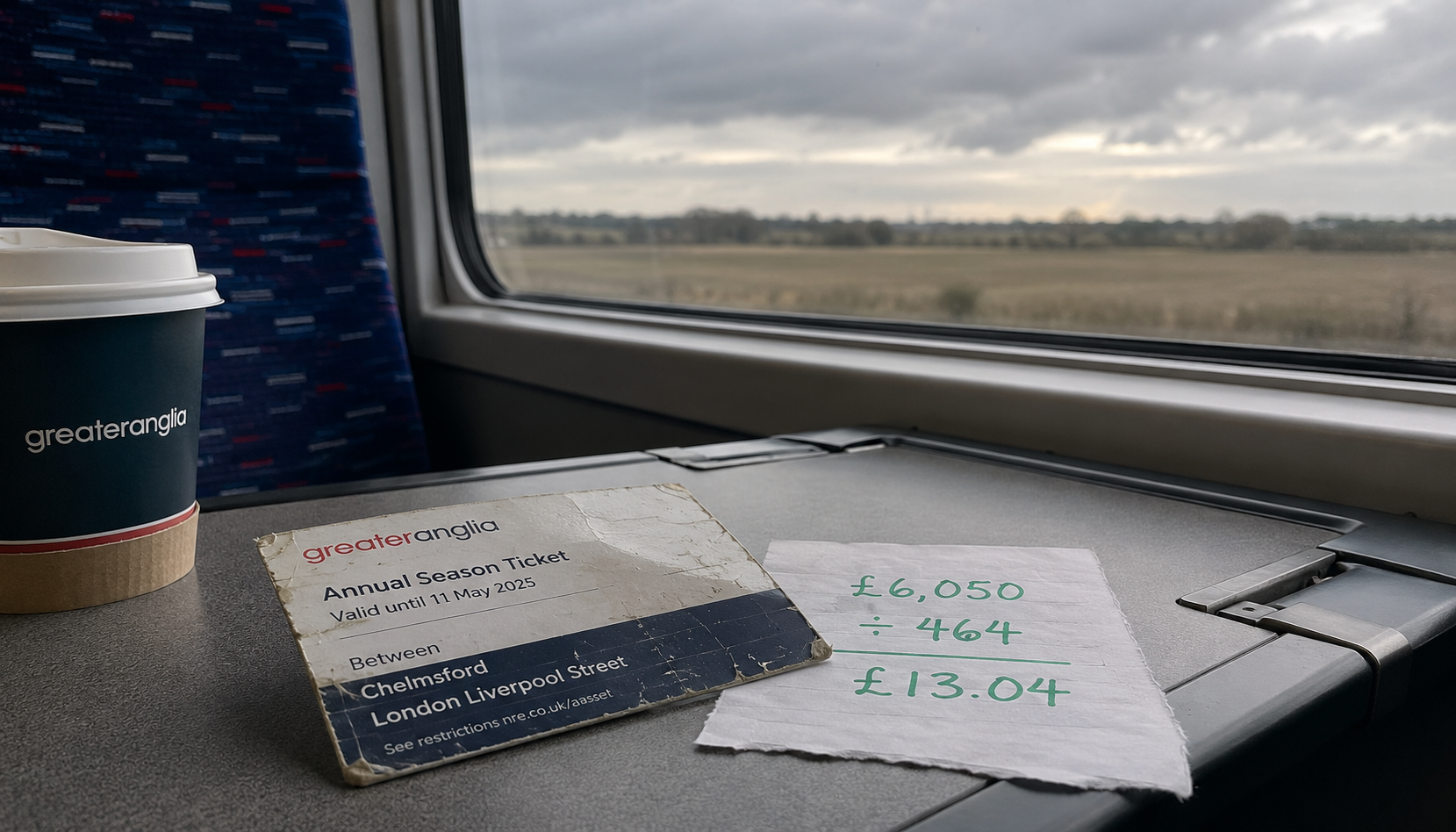
£6,050 ÷ 464 = £13.04. That is what Greater Anglia charges you for a single leg. When it arrives late, the maths works the other way too — and most passengers never run it.
Rail Repay Podcast
Your Season Ticket in Pounds Per Day — and Why Every Delay Has a Price Tag
Enjoy the related dialogue — a two-voice conversation on this topic.
£6,050 ÷ 464 = £13.04.
You have probably never seen that calculation before. Most commuters haven't. But it is exactly how Greater Anglia calculates the value of your single journey — and it is the number at the centre of every Delay Repay claim you may be owed.
The January renewal notice arrived. You budgeted for it. You didn't like it. You paid it anyway. That is where most commuters stop — at the total, the annual hit, the number that made you wince. What they don't do is divide it by 464.
The Maths Greater Anglia Uses
The National Rail Conditions of Travel set the framework. For an annual season ticket, the value of a single journey is:
Ticket price ÷ 464 = single-leg value
The figure 464 represents two journeys per day, five days per week, for 46.4 working weeks — the industry's agreed annual commuting baseline. It is the same formula applied consistently across UK rail operators.
For a Colchester to London Liverpool Street annual season ticket in 2025-26, priced at approximately £6,050:
£6,050 ÷ 464 = £13.04 per single leg
That is the value of one journey. Not an approximation — the specific monetary value Greater Anglia assigns to each trip when calculating what it owes you if it runs late.
What That Means in Practice
Greater Anglia's Delay Repay 15 scheme pays compensation on a sliding scale tied to that per-leg value:
| Delay at destination | Compensation |
|---|---|
| 15–29 minutes | 25% of single-leg value |
| 30–59 minutes | 50% of single-leg value |
| 60–119 minutes | 100% of single-leg value |
| 120+ minutes | 100% of return value (2 × single leg) |
Applied to our £6,050 ticket:
- •15–29 min delay: £3.26
- •30–59 min delay: £6.52
- •60–119 min delay: £13.04
- •120+ min delay: £26.08
The Year in Numbers
Greater Anglia's own performance data, published quarterly by the ORR, indicates that passengers on busy commuter routes can reasonably expect 15 or more qualifying delays per year — journeys arriving 15 minutes or more late at their destination.
At an average compensation of around £5 per qualifying delay — weighted across the distribution of delay lengths — that is £75 per year in potential claims. At the upper end, for passengers who encounter several longer delays, it can reach £150 to £200.
That money is legally available to claim. The scheme exists. The rights are established under the National Rail Conditions of Travel. The clock starts the moment the delay occurs — and runs for 28 days.
Most of it goes unclaimed.
Why the Per-Leg Number Matters
There is a psychological reason that knowing your per-leg value changes your behaviour.
"My train was late again" is vague. Frustrating, certainly, but abstract. "My train was 35 minutes late, and I am owed £6.52 back" is specific. It has a number attached. It is a transaction that has not been completed.
Most people would not leave £6.52 on the platform. They would not accept a bill that was £6.52 too high and say nothing. The money is theirs by right — not as a favour, not as a goodwill gesture, but as a formal entitlement under the terms of the service they paid for.
The ticket you bought for £6,050 is a contract. When Greater Anglia fails to deliver on its side of that contract — arriving within the scheduled time — the 1/464 formula is how you calculate what it owes you.
I realised this properly one morning at Colchester North. The 07:44 board went from "On time" to "Delayed — 31 minutes" before I had even found a seat. Thirty-one minutes. I knew the number immediately: £6.52. It was not abstract any more. It was mine.
The Calculation You Should Not Have to Do Manually
In practice, most commuters do not know the exact divisor Greater Anglia uses. They do not have the 1/464 formula saved anywhere. When they get home after a 40-minute delay, tired and hungry, the last thing they reach for is a calculator.
This is not a criticism. It is how the system works, and time does the rest of the work for the train company.
Rail Repay exists to close that gap. When you register your Greater Anglia route and ticket type, the compensation calculation happens automatically. When a qualifying delay occurs — 15 minutes or more at your destination — you receive an email that day. Your account shows the AI-drafted claim text, ready to copy into Greater Anglia's own portal.
The maths is done. The text is written. The 28-day clock has barely started.
A Quick Note for Different Ticket Types
The 1/464 formula applies to annual season tickets. Other tickets have different divisors:
- •Monthly season ticket: price ÷ 40 = single-leg value
- •Weekly season ticket: price ÷ 10 = single-leg value
- •Day return or single fare: face value of the fare
The principle is the same across every ticket type: the delay has a specific price tag. You paid for the journey. If it arrived late, the scheme owes you a defined proportion of what you paid.
One more thing worth knowing: if you hold a Railcard, the compensation is calculated on the discounted price you actually paid — not the full fare. It still counts. It is still worth claiming.
The Takeaway
Your annual season ticket to London costs roughly £6,050. That is £13.04 per single leg, by Greater Anglia's own calculation method. A 30-minute delay is worth £6.52. Fifteen such delays in a year is £97.50.
That number is available to claim. Most passengers who experience those delays never collect it.
You do not have to be one of them.
Check what you may be owed — free, no card needed — at railrepay.co.uk.
Sources:
- •National Rail Conditions of Travel 2025, Clause 32 and Appendix — nationalrail.co.uk
- •Greater Anglia Delay Repay — greateranglia.co.uk
- •ORR Rail Performance Statistics Q4 2024-25 — orr.gov.uk
Stop leaving money on the platform
Check what your Greater Anglia route may owe you — in 60 seconds
Free delay alerts + AI claim drafts. No card required. You stay the claimant.
You might also like

This article is informational and is not legal advice. See the legal basis and sources. The train company decides the final eligible amount after validating your ticket, journey, and delay evidence. Legal basis and sources